While the Rest of San Francisco Surged in 2026, Nob Hill Prices Fell. Here's the Real Reason.
If you have spent any time this year watching San Francisco listings, you have probably absorbed the headline version of the 2026 market: single-family homes up 25 to 40 percent in a lot of neighborhoods, homes selling a million or two over asking, luxury sales climbing at a pace that has surprised even agents who have worked through past booms.
Nob Hill did not get the memo. As of February 2026, Redfin data put the neighborhood's median sale price down 11.9 percent year over year, at $1.2 million. By March 2026, Movoto reported Nob Hill's price per square foot down roughly 10 percent compared with the same month in 2025. Meanwhile, its two closest hill neighbors moved the other direction. Across the first two quarters of 2026, condo sales tracked through San Francisco MLS put Russian Hill's median price per square foot near $1,322 and Pacific Heights near $1,272, both comfortably ahead of Nob Hill's roughly $1,189.
The easy read is that Nob Hill cooled while the hill next door heated up. That is not quite what happened. The gap has less to do with how much buyers want Nob Hill and more to do with what they are actually buying when they buy there.
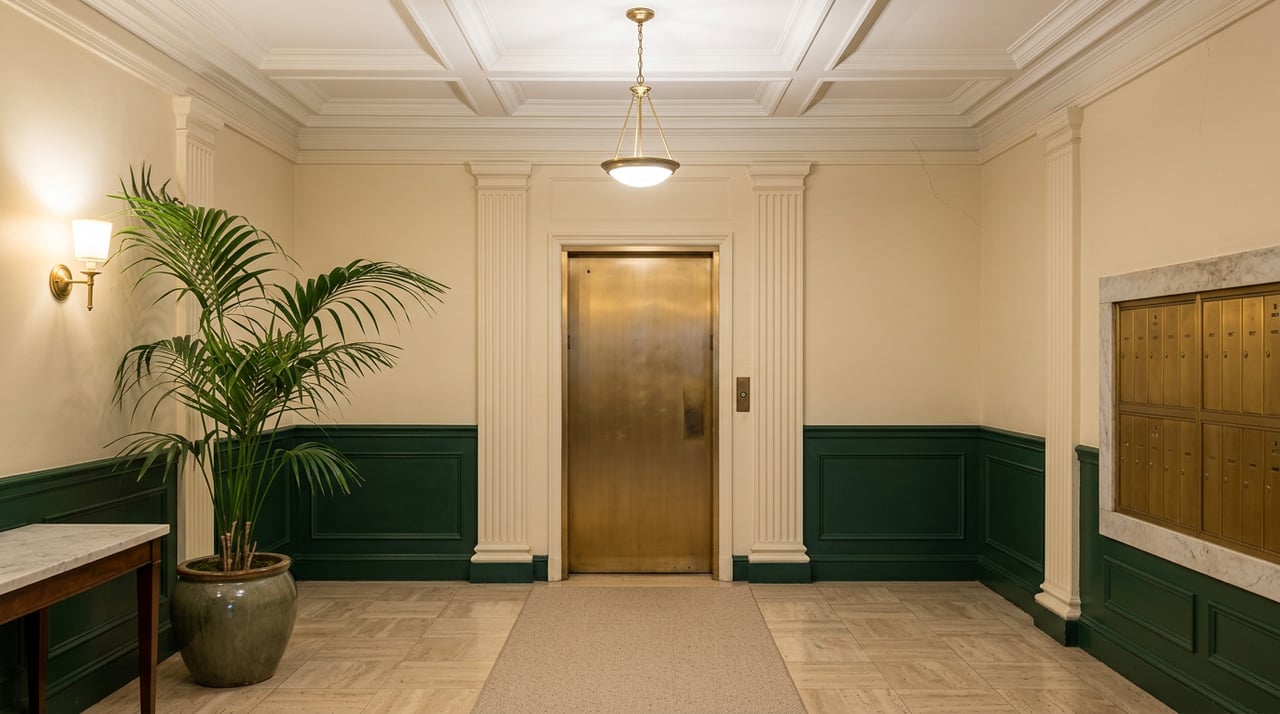
Nob Hill's luxury inventory leans heavily on prewar stock cooperatives, a structure that is far less common in Russian Hill or Pacific Heights. Buildings like The Comstock, a 130-unit cooperative tower at 1333 Jones Street completed in 1961, and Cathedral Apartments at 1201 California Street are long-standing examples. In a co-op, you are not buying a deed to a unit. You are buying shares in the corporation that owns the entire building, along with a proprietary lease that gives you the right to occupy a specific apartment.
That distinction sounds like paperwork until you try to finance it.
Condos in Russian Hill and Pacific Heights finance the way most single-family homes do. Any conventional lender can underwrite the loan, appraisal standards are familiar, and a buyer's approval rests almost entirely between them and their bank. Co-ops work differently. Fewer lenders offer share loans at all, down payment expectations commonly run from 20 percent up toward 50 percent depending on the building, and some buildings only accept all-cash offers. On top of the lender's requirements, the co-op's own board reviews the buyer separately, and that board can decline a sale price it believes undervalues the building for every other shareholder.
That second layer of approval is not a formality. A buyer moving into a Nob Hill co-op should expect to submit an application, sit for a board interview, and produce the kind of documentation a condo purchase never asks for.
Before a co-op board signs off, expect a request for some combination of the following, and expect to gather it early rather than after you are already in contract:
None of this is unusual by co-op standards nationally. It is unusual by San Francisco standards, where the market has been built almost entirely around condo and single-family transactions for decades. That mismatch between a familiar process and an unfamiliar one is a real part of why Nob Hill inventory trades at a discount per square foot. The pool of buyers who can clear a co-op board, on top of clearing a lender, is simply smaller than the pool who can close on a condo.
The clearest evidence of that narrower pool shows up in how listings actually compete once they hit the market. Recent Redfin listing data for the two neighborhoods shows Nob Hill condos drawing around one offer on average, while Russian Hill listings in the same window were drawing about six. Days on market look similar across sources through 2026, with Nob Hill condos typically selling somewhere between 42 and 67 days depending on the month and source, and Russian Hill running in a comparable 30 to 70 day range given its smaller sample of closed sales.
Similar timelines, very different levels of competition per listing. That is the signature of a market where demand for the location has not disappeared, but the number of buyers equipped to actually transact on any given listing has.
There is a seller-side version of this same story. Some owners on Nob Hill and Russian Hill who bought during 2016 or 2017 are not yet positioned to sell at a profit, a gap that is closing but has not closed everywhere. Older, larger buildings on both hills, many from the early 1900s, also carry a real risk of deferred maintenance and infrastructure costs that can surface as special assessments well after closing. That risk sits on top of co-ops and condos alike. It is a reason to read building disclosures closely rather than a reason to avoid either hill.
One case worth knowing if you are shopping either hill involves 1170 Sacramento Street, the 19-story Nob Hill Condominiums. Built in 1963 and designed by John Carl Warnecke and T.Y. Lin, the 71-unit building went through a seismic evaluation and retrofit designed to address the building's most critical vulnerabilities while letting every resident remain in their unit throughout the work. The project was structured to be funded by the residents themselves.
That is exactly the kind of cost that shows up as a special assessment rather than a line item in a listing description. Whether you are evaluating a condo or a co-op on either hill, ask for the reserve study and recent board minutes before you write an offer, not after. A building with healthy reserves rarely needs a large assessment. A building without them eventually does, and the bill lands on whoever owns the unit when the work becomes unavoidable.
Russian Hill and Pacific Heights avoided Nob Hill's 2026 slide largely because their inventory looks different. Both lean toward condominiums and converted flats rather than cooperatives, which means a much wider set of buyers can compete for any given listing. Russian Hill's stock also skews larger, with a median condo sale near $2.51 million across the first half of 2026 compared with Nob Hill's roughly $1.40 million, and many homes there carry direct Golden Gate Bridge or bay views that add their own premium. Pacific Heights posted the highest single sale of the three hills at roughly $8.0 million, against $7.4 million on Nob Hill and $5.85 million on Russian Hill, though that Russian Hill figure rests on a thinner sample and should be read as directional.
None of these three hills sell the same product. Nob Hill sells central, hotel-anchored prestige with a meaningful share of cooperative ownership. Russian Hill sells scenic, condo-dominant residential blocks. Pacific Heights sells scale. Price per square foot captures some of that difference, but it is measuring ownership structure and unit size as much as it is measuring desirability.
A lower price per square foot on Nob Hill is not automatically a better deal, and a higher one on Russian Hill is not automatically a worse one. What matters is matching the ownership structure to your financing and your timeline. Before you fall for a number, find out whether the listing is a condo, a co-op, or a TIC. If it is a co-op, get pre-approved with a lender who actually writes share loans before you go looking, and ask your agent to request the board package early so you know what you are walking into rather than discovering it mid-escrow.
Is a Nob Hill co-op actually cheaper to own than a comparable condo? The purchase price is often lower, but monthly costs can run higher once you add the share loan payment to the co-op's maintenance charge, which typically bundles property taxes, building insurance, and sometimes an underlying mortgage. Ask for a full breakdown before comparing it against a condo's mortgage plus HOA dues.
Can I get a normal mortgage for a Nob Hill co-op? Not in the conventional sense. Co-ops use share loans secured by your stock and proprietary lease rather than a deed, and the pool of lenders who offer them is smaller. Lining up a co-op-experienced lender before you shop will save real time later.
Does Nob Hill's 2026 price dip mean it's a bad time to buy there? It means the math is different, not worse. A smaller qualified buyer pool has kept price growth soft even as demand for the location itself has not gone anywhere. For a buyer who can clear the financing and board process, that is closer to an opening than a warning sign.
Comparing hills on price per square foot alone will tell you less than you think. What actually determines whether a Nob Hill or Russian Hill purchase closes smoothly is the ownership structure underneath the listing, and that is exactly the kind of detail that rewards working with someone who has been inside these board packages before. If you are weighing a purchase on either hill, or wondering what your own Nob Hill or Russian Hill property is really worth in this market, Sage Real Estate can walk you through the specifics before you write an offer.
Stay up to date on the latest real estate trends.
You’ve got questions and we can’t wait to answer them.