The Two Condo Markets Hiding Inside Pacific Heights and the Marina
San Francisco's condo market had its tightest July in years. One closely watched citywide report put the median condo price at $1,250,000 for July 2026, up 8.93 percent from a year earlier, with inventory down 43 percent year over year to just 353 units and the average listing clearing in 20 days instead of the 43 it took the previous summer. Read that on its own and the story writes itself: condos finally caught up to houses, buyers have less to choose from, and the market moved fast enough that waiting cost people money.
So why did a fully renovated three-bedroom, three-and-a-half-bath flat with parking on California Street in Pacific Heights show up on the market this past June as a $2.3 million tenancy in common instead of a listing closer to the $3.2 million an average Pacific Heights condo commands? And why did buyers in Noe Valley and the Marina spend this past spring bidding on flats the way they'd bid on a detached house, while a few miles away in SOMA and Mission Bay, similar-looking condos traded at or just above list without the drama?
The citywide number is real. It just isn't describing one market. It's averaging two.
A San Francisco market report covering closed sales through the spring of 2026 broke this out directly: condos in Districts 5 and 7 (Noe Valley, the Castro, Pacific Heights, the Marina) are trading with the same competitive intensity as single-family homes, while condos in Districts 8 and 9 (SOMA, Mission Bay, the ballpark corridor) are behaving like a more liquid, standardized product that sells close to list.
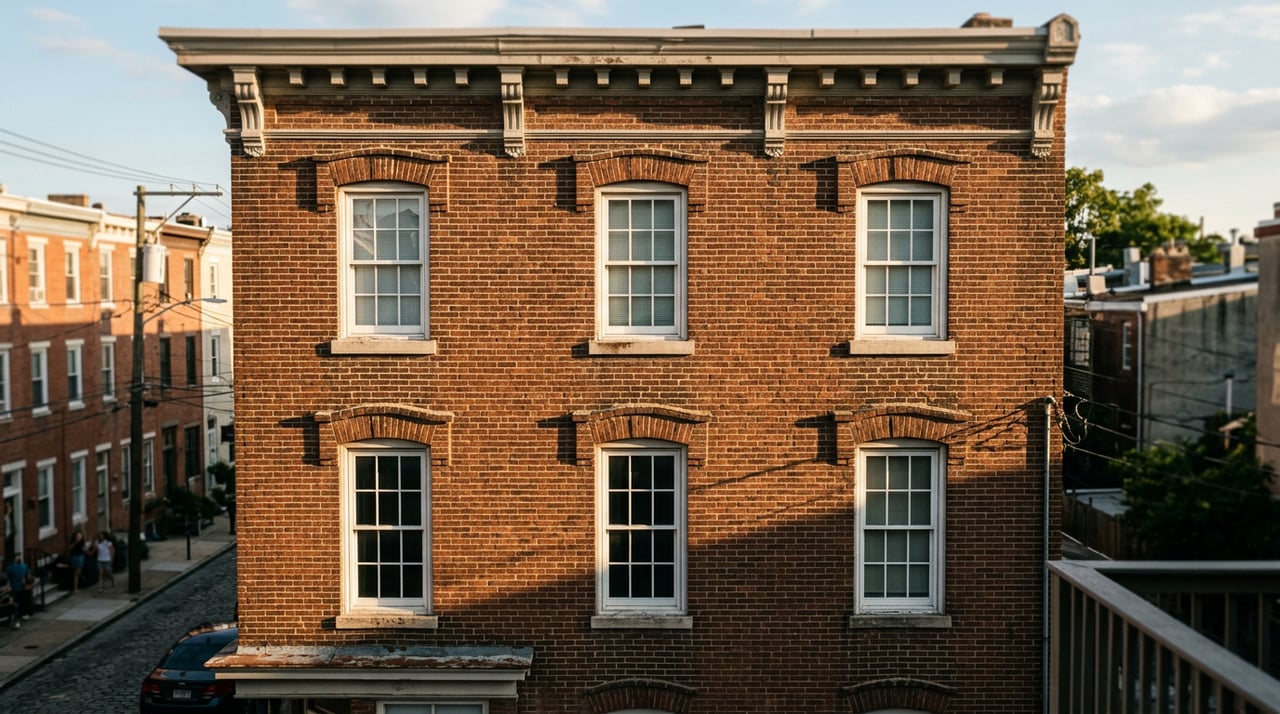
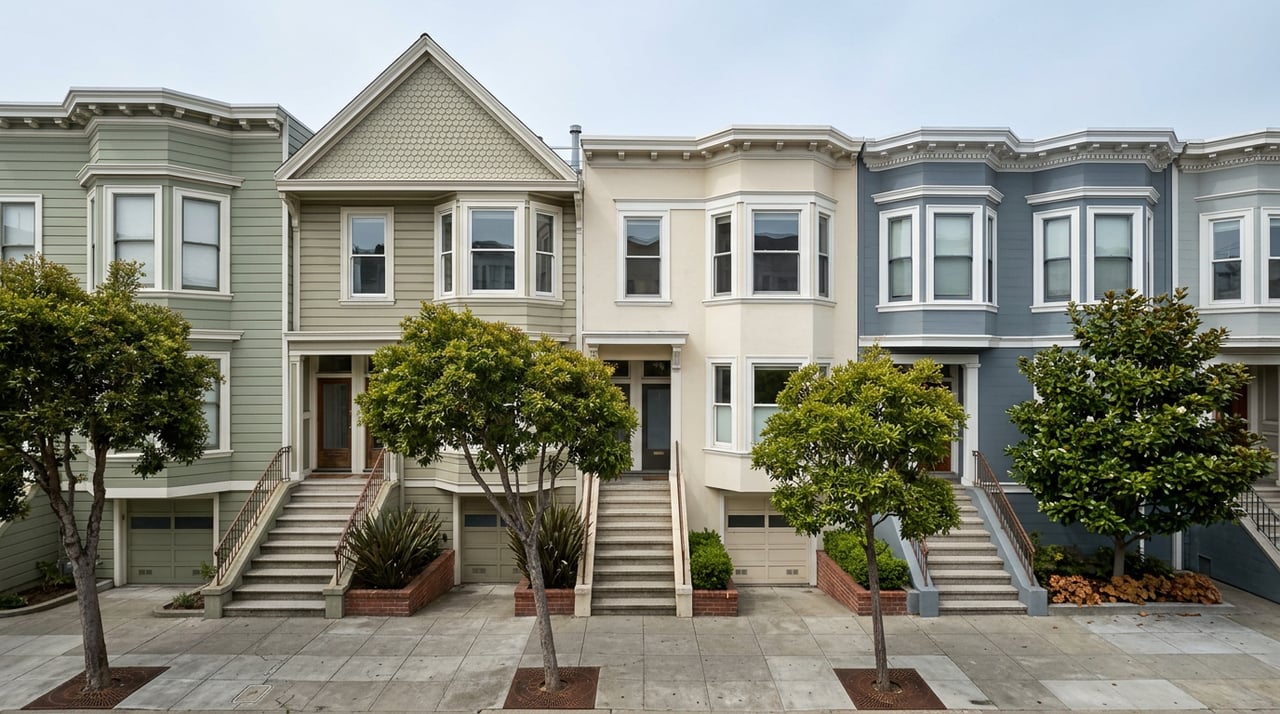
The reason isn't buyer sentiment. It's what's actually being sold. What gets called a "condo" in Pacific Heights or the Marina is frequently a converted flat inside a 1900s or 1920s Edwardian or Victorian building, sometimes a former TIC that went through condo conversion, sometimes one unit of a boutique two-to-four-unit building with no two floor plans quite alike. What gets called a condo in District 8 or 9 is far more often a unit in a purpose-built high-rise with dozens of comparable units, a standing HOA, and a deep appraisal record. One of those product types has enough identical comps that pricing is almost mechanical. The other doesn't, so buyers end up pricing it the way they'd price a house: by instinct, by competition, and by how badly they want that specific building on that specific block.
The same report noted that in the 2-to-4-unit category, the price premium per square foot over single-family homes came in around $609 per square foot on combined living area, a narrower gap than the reputation of these buildings would suggest. That's a second signal pointing the same direction: buyers aren't paying a wild premium for scarcity, they're paying something closer to house pricing because, functionally, that's what they're buying.
If you've been told to wait for San Francisco's condo squeeze to loosen before you write an offer in Pacific Heights or the Marina, the citywide data won't get you there. The July numbers show tightening, not loosening. A converted Edwardian flat in these two neighborhoods isn't competing against a glut of interchangeable high-rise units. It's competing against a small, slow-moving pool of similarly idiosyncratic buildings, which is exactly the condition that keeps single-family home markets tight even when broader inventory grows.
This is where the TIC discount stops being a footnote and starts being the more useful lever.
A tenancy in common review of San Francisco's market covering January through May 2026 tracked 120 TIC sales citywide at a median price of $1.2 million. Of those, 93 were in buildings with three or more units, and that group sold for an average of 7.5 percent over asking. Sales activity concentrated in a short list of neighborhoods where condo prices run considerably higher, including Pacific Heights, the Marina, Noe Valley and Eureka Valley, the Mission, and Nob Hill and Telegraph Hill.
Most of that activity stayed modest. Roughly 70 percent of TIC sales in that window closed below $1.5 million. Only 22 sales crossed that threshold, and just one broke $2 million: a two-level penthouse in a three-unit Telegraph Hill building at 430 Greenwich, listed at $3,295,000 and sold for $3,470,000 in February 2026, with two-car parking and a private elevator among the finishes that pushed it there.
Back in Pacific Heights, the same June 2026 review of active inventory put a fully renovated three-bedroom, three-and-a-half-bath TIC flat with parking at 3052 California Street on the market at $2.3 million, against an average Pacific Heights condo price near $3.2 million. That's roughly a $900,000 gap on paper, wider than the 10 to 20 percent discount that shows up consistently across 2026 market commentary as the typical TIC-to-condo spread. The width varies by building, by unit count, and by how clean the co-ownership structure is, which is the entire reason a buyer needs someone reading the specific building rather than the average.
The discount is real, but it isn't free. It exists because TIC financing is a smaller, slower, more specialized market than condo financing, and that friction shows up at every stage of a transaction.
A handful of institutions, including Sterling Bank and Trust and Redwood Credit Union, offer individual TIC loans in the Bay Area, and most conventional mortgage lenders simply don't touch fractional ownership. Compared to a standard condo purchase, buyers should expect:
The other assumption worth correcting before an offer goes in: converting a TIC to a condo won't happen on the timeline a buyer hopes for.
Is a TIC always cheaper than the equivalent condo in Pacific Heights or the Marina? Usually, but the gap moves. Current market commentary points to a 10 to 20 percent discount as typical, though individual comps like the Pacific Heights example above can run wider depending on the building's financing structure and condition.
Will condo prices in these neighborhoods move in step with the citywide market? The citywide July 2026 numbers show tightening, but don't establish how more standardized, higher-inventory condo stock compares with the converted flats and boutique buildings that make up most of the condo inventory in Pacific Heights and the Marina.
How much longer should I plan for a TIC closing versus a condo closing? Budget 45 to 75 days from accepted offer for most TIC purchases, driven mainly by TIC agreement review and lender underwriting, against roughly 30 days for a conventional condo purchase.
The number on the citywide report is accurate. It's also describing a different building than the one you're bidding on. Knowing which market you're actually in, and pricing the discount and the timeline that come with it, is the difference between a TIC that works and one that costs more than it saved.
If you're weighing a TIC against a condo in Pacific Heights, the Marina, or anywhere else in the city, Sage Real Estate can walk you through the specific building's financing structure, comps, and conversion history before you write an offer. Discover what your home is worth, or what the next one should actually cost you.
This article is general information, not legal, tax or financial advice. Consult a qualified professional about your situation.
Stay up to date on the latest real estate trends.
You’ve got questions and we can’t wait to answer them.